Category
🗄️

Database

Managed database APIs — SQL, vector, time-series, graph, and NoSQL — with serverless scaling, generous free tiers, and sub-10ms latency from providers like Supabase, PlanetScale, and Pinecone.

4APIs
Most Popular In
Relational SQLVector DatabasesTime-Series
Auth Breakdown
API Key75%
No Auth25%
Notable Developers
SupabaseNeonPineconeMongoDB AtlasUpstash
Updated Jun 12, 2026
Curated by FreeAPIHub editors
Topics:Relational SQLVector DatabasesTime-SeriesGraph DatabasesDocument StoresKey-Value & Cache
4 of 4
Access:
Auth:
Format:
TimescaleDB API logo

TimescaleDB API

🔥 Hot
Database

TimescaleDB is an open-source PostgreSQL extension for time-series data. It adds hypertables, continuous aggregates and compression to Postgres, so you store and query huge time-series with plain SQL.

FreemiumNo Auth
View details
Supabase Vector API logo

Supabase Vector API

🔥 Hot
Database

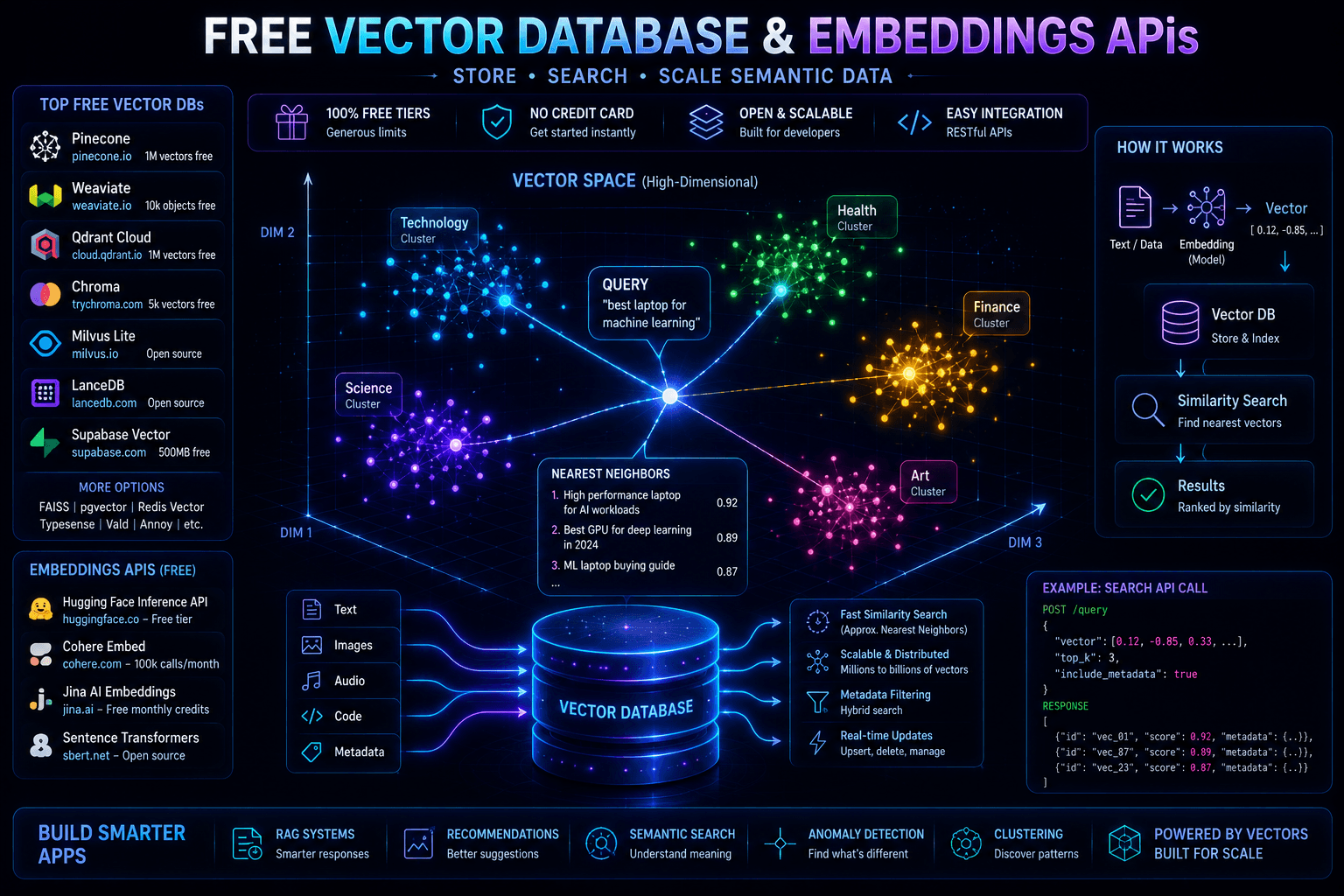
Supabase Vector is the vector-database capability of Supabase, built on Postgres and pgvector, for storing embeddings and running SQL similarity search for RAG and recommendations.

FreemiumAPI Key
View details
Qdrant Vector Search logo

Qdrant Vector Search

🔥 Hot
Database

Qdrant is an open-source vector database and similarity-search engine in Rust, storing embeddings with payloads and finding nearest matches for RAG, semantic search and recommendations.

FreemiumAPI Key
View details
NocoDB API logo

NocoDB API

🔥 Hot
Database

NocoDB is an open-source Airtable alternative that turns any database into a smart spreadsheet and auto-generates REST and GraphQL APIs for every table - self-hosted, with API-token auth.

Free tierAPI Key
View details
Showing 4 of 4 resources

At a glance

Compare the top Database APIs

Browse all APIs
APIAccessAuthFormatsRating
TimescaleDB API logo
TimescaleDB API
FreemiumNo AuthRESTJSONView
Supabase Vector API logo
Supabase Vector API
FreemiumAPI KeyRESTJSONView
Qdrant Vector Search logo
Qdrant Vector Search
FreemiumAPI KeyRESTJSONView
NocoDB API logo
NocoDB API
Free tierAPI KeyRESTJSONView

About this category

Database — developer guide

What Are Database APIs?

Database APIs give applications managed, API-first access to persistent storage without the operational burden of self-hosted servers, replication, backups, and upgrades. The modern API-first database ecosystem covers every storage pattern — relational SQL for structured transactional data, vector stores for AI-powered semantic search, time-series for IoT and metrics, graph databases for relationship-heavy data, and document stores for flexible schemas. Most providers offer serverless models that scale to zero, making free-tier prototyping nearly unlimited.

Storage Patterns and the Right Database

  • Relational SQL (Supabase, PlanetScale, Neon) — user records, orders, financial transactions
  • Vector databases (Pinecone, Weaviate, pgvector) — semantic search, RAG pipelines, recommendations
  • Time-series (InfluxDB, TimescaleDB) — IoT sensor data, application metrics, financial tick data
  • Graph databases (Neo4j, FalkorDB) — social networks, fraud graphs, knowledge bases
  • Document stores (MongoDB Atlas, Firestore) — flexible schemas, hierarchical content, catalogs
  • Key-value / cache (Upstash Redis) — session storage, rate limiting, real-time leaderboards

Choosing a Managed Database in 2026

Supabase is the most popular open-source alternative to Firebase — it bundles PostgreSQL, auth, storage, and real-time subscriptions in one platform with a generous free tier. Neon offers serverless PostgreSQL with branching (like git for your database), ideal for preview environments. Pinecone remains the leading managed vector store for production RAG applications. PlanetScale suits MySQL workloads requiring horizontal sharding without downtime migrations. Upstash provides serverless Redis and Kafka with per-request pricing — cost-efficient for bursty workloads.